

Your goal
Describe a repeated learning habit and use before and after to order actions.
Read the story
Every Tuesday, Mina helps at a small repair workshop near the bus station. Visitors bring broken lamps, loose handles, and bags with damaged straps. Mina welcomes them and writes a short description of each problem. She enjoys the work, but she sometimes forgets the English names of simple tools. Last week, she asked for the long silver thing because she could not remember the word screwdriver. Her colleague Joel understood, but Mina wanted to explain things more clearly to visitors who spoke English.
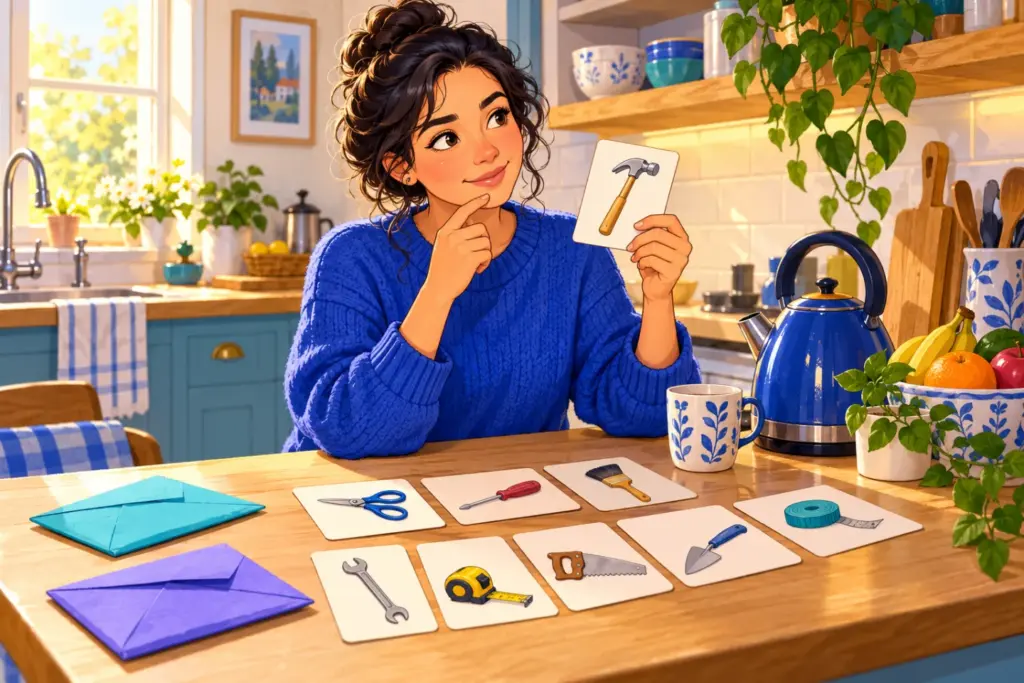
At home, Mina made eight cards from an empty cereal box. She wrote a tool name on one side and drew a small picture on the other. She put the cards beside the kettle, where she could see them every morning. Before she looked at each word, she tried to name the picture. After she checked her answer, she made a sentence about the tool. She did not count a familiar picture as a correct answer unless she could say its name without turning the card over.
On Wednesday, Mina remembered five names. She placed those cards in a second envelope and kept the other three beside the kettle. On Thursday, she mixed all eight cards again. The word for a small metal fastener disappeared from her mind, although it had seemed easy the day before. Instead of starting the whole set again, she checked that card and described where the object went. A screw holds this handle in place, she said to the empty kitchen. The sentence gave her something useful to practise.
Joel noticed the cards when he visited on Saturday. He offered to ask the questions in a different order. Mina answered most of them, then asked him to describe a repair without naming the tool. This was harder than looking at pictures. She had to connect the words with a real job. They spent ten minutes on the activity before they cooked lunch. Mina wrote a small question mark on two cards so she would remember which words needed another attempt.
The following Tuesday, a visitor needed help with a cupboard door. Mina asked for a screwdriver and explained the loose screw clearly. Later, she forgot another name and checked her notebook. She was still learning, and that was acceptable. Before she left the workshop, she added two new cards to her envelope. Her plan was simple: try an answer, check it, and return to it later. She wanted useful words she could recall during a conversation, as well as words she recognised on paper.
A conversation to practise
Joel: What do you do before you look at the answer?
Mina: I try to recall the word from the picture.
Joel: And what happens after you check it?
Mina: I use it in a sentence about a real repair.
Understand the story
- Why did Mina want to learn the tool names?
- Where did Mina keep the cards she needed to practise?
- How did Joel make the activity harder?
Practise the language
- Complete with before or after: Mina tries to name the picture ___ she turns the card over.
- Complete with before or after: ___ she checks the answer, she makes a sentence with the correct word.
- Rewrite as one sentence beginning with Before: I check the spelling. First, I write the word.
Vocabulary & explanations
English
Your goal
Describe a repeated learning habit and use before and after to order actions.
Useful vocabulary
- tool
- An object used to do a practical job.Put each tool back in the blue box.
- recall
- To bring something back to mind.Can you recall the name without opening your notebook?
- check
- To look at something to see whether it is correct.I check the spelling after I write the word.
- envelope
- A paper cover that holds a letter or small items.The green envelope contains six picture cards.
- mix
- To put things together in a different order.Mix the cards before the next round.
- attempt
- An effort to do something.My second attempt was more accurate.
- loose
- Not firmly fixed in place.This loose handle needs a new screw.
- recognise
- To know something because you have seen it before.I recognise the word, but I cannot spell it yet.
Ordering actions with before and after
Before means earlier than another action; after means later. Use a subject and verb after either word: Before Mina checks, she tries an answer. After she checks, she makes a sentence. A clause at the beginning is followed by a comma.
- Before I turn the card over, I say the word.
- After Joel asks a question, Mina answers.
- I check my answer after I write it.
Make it yours
Choose four useful English words. Cover them and try to recall them. Write six sentences describing what you do before and after checking your answers, including one example sentence for a difficult word.
Check and remember
Without looking, recall three workshop words. Explain the difference between recognising a word and recalling it. Say one sentence with before and one with after.
Français
Votre objectif
Décrire une habitude d’apprentissage répétée et utiliser before et after pour ordonner les actions.
Vocabulaire utile
- tool
- Outil utilisé pour effectuer un travail pratique.Put each tool back in the blue box.
- recall
- Se rappeler quelque chose.Can you recall the name without opening your notebook?
- check
- Vérifier si quelque chose est correct.I check the spelling after I write the word.
- envelope
- Enveloppe en papier pour une lettre ou de petits objets.The green envelope contains six picture cards.
- mix
- Mélanger des éléments pour changer leur ordre.Mix the cards before the next round.
- attempt
- Tentative pour faire quelque chose.My second attempt was more accurate.
- loose
- Qui n’est pas bien fixé.This loose handle needs a new screw.
- recognise
- Reconnaître une chose déjà vue.I recognise the word, but I cannot spell it yet.
Ordonner les actions avec before et after
Before signifie « avant que » et after « après que ». Chaque mot peut introduire un sujet et un verbe : Before Mina checks, she tries an answer. After she checks, she makes a sentence. Une proposition placée au début est suivie d’une virgule.
- Before I turn the card over, I say the word.
- After Joel asks a question, Mina answers.
- I check my answer after I write it.
À vous de jouer
Choisissez quatre mots anglais utiles. Cachez-les et essayez de les retrouver. Écrivez six phrases décrivant vos actions avant et après la vérification, dont un exemple avec un mot difficile.
Vérifier et retenir
Sans regarder, retrouvez trois mots de l’atelier. Expliquez la différence entre reconnaître un mot et le retrouver de mémoire. Faites une phrase avec before et une avec after.
Español
Tu objetivo
Describir un hábito de aprendizaje repetido y usar before y after para ordenar acciones.
Vocabulario útil
- tool
- Herramienta para realizar un trabajo práctico.Put each tool back in the blue box.
- recall
- Recordar algo.Can you recall the name without opening your notebook?
- check
- Comprobar si algo es correcto.I check the spelling after I write the word.
- envelope
- Sobre de papel para una carta u objetos pequeños.The green envelope contains six picture cards.
- mix
- Mezclar elementos para cambiar su orden.Mix the cards before the next round.
- attempt
- Intento de hacer algo.My second attempt was more accurate.
- loose
- Que no está bien sujeto.This loose handle needs a new screw.
- recognise
- Reconocer algo que se ha visto antes.I recognise the word, but I cannot spell it yet.
Ordenar acciones con before y after
Before indica que una acción ocurre antes y after que ocurre después. Usa un sujeto y un verbo: Before Mina checks, she tries an answer. After she checks, she makes a sentence. Si esta parte va al principio, lleva una coma al final.
- Before I turn the card over, I say the word.
- After Joel asks a question, Mina answers.
- I check my answer after I write it.
Hazlo tuyo
Elige cuatro palabras útiles en inglés. Tápalas e intenta recordarlas. Escribe seis oraciones sobre lo que haces antes y después de comprobar las respuestas, incluida una oración con una palabra difícil.
Comprobar y recordar
Sin mirar, recuerda tres palabras del taller. Explica la diferencia entre reconocer una palabra y recordarla. Di una oración con before y otra con after.
العربية
هدفك
وصف عادة تعلم متكررة واستخدام before وafter لترتيب الأفعال.
مفردات مفيدة
- tool
- أداة تستخدم لإنجاز عمل عملي.Put each tool back in the blue box.
- recall
- استرجاع شيء من الذاكرة.Can you recall the name without opening your notebook?
- check
- فحص شيء للتأكد من صحته.I check the spelling after I write the word.
- envelope
- ظرف ورقي لحفظ رسالة أو أشياء صغيرة.The green envelope contains six picture cards.
- mix
- خلط أشياء لتغيير ترتيبها.Mix the cards before the next round.
- attempt
- محاولة لفعل شيء.My second attempt was more accurate.
- loose
- غير مثبت بإحكام.This loose handle needs a new screw.
- recognise
- التعرف على شيء سبق أن رأيته.I recognise the word, but I cannot spell it yet.
ترتيب الأفعال باستخدام before وafter
تعني before أن الفعل يحدث قبل فعل آخر، وتعني after أنه يحدث بعده. استخدم فاعلاً وفعلاً بعدهما: Before Mina checks, she tries an answer. After she checks, she makes a sentence. إذا جاءت هذه الجملة في البداية، تتبعها فاصلة.
- Before I turn the card over, I say the word.
- After Joel asks a question, Mina answers.
- I check my answer after I write it.
دورك الآن
اختر أربع كلمات إنجليزية مفيدة. أخفها وحاول تذكرها. اكتب ست جمل تصف ما تفعله قبل التحقق من إجاباتك وبعده، مع جملة مثال لكلمة صعبة.
راجع وتذكّر
تذكر ثلاث كلمات من الورشة دون النظر. اشرح الفرق بين التعرف على كلمة واسترجاعها من الذاكرة. قل جملة باستخدام before وأخرى باستخدام after.
Check your answers
Story answers
- She wanted to explain repairs more clearly to English-speaking visitors.
- She kept them beside the kettle.
- He described a repair without naming the tool, so Mina had to choose the word.
Language answers
- before — Her attempt happens first, so use before.
- After — Checking happens first; making the sentence follows it.
- Before I check the spelling, I write the word. — Before introduces the later action here; writing still happens first.
Français
- La tentative a lieu en premier : utilisez before.
- La vérification vient en premier, puis la création de la phrase.
- Before introduit ici l’action qui suit : écrire a toujours lieu en premier.
Español
- El intento ocurre primero, por eso se usa before.
- Primero comprueba la respuesta y después crea la oración.
- Before introduce aquí la acción posterior; escribir sigue ocurriendo primero.
العربية
- تحدث المحاولة أولاً، لذلك نستخدم before.
- تتحقق من الإجابة أولاً، ثم تكوّن الجملة.
- تقدم before هنا الفعل اللاحق؛ وتبقى كتابة الكلمة هي الفعل الأول.