

Your goal
Discuss uncertain plans using the first conditional.
Read the story
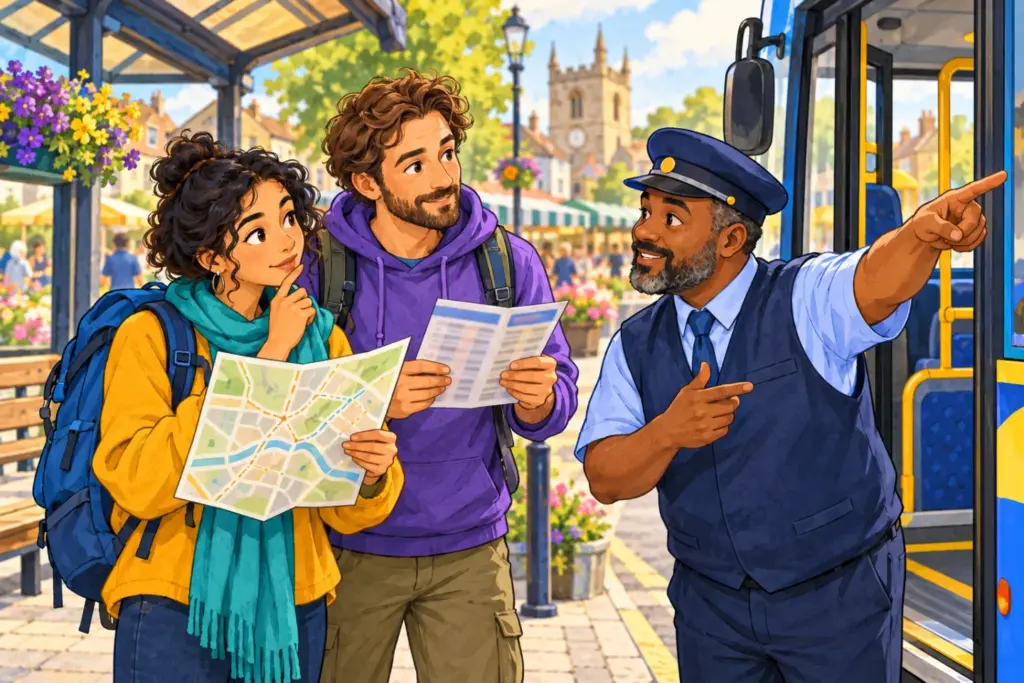
Leila had promised herself a small adventure after finishing a long translation project. She chose a day trip to a market town she had never visited, taking a regional bus instead of driving. Her friend Owen agreed to come, provided that they left time for lunch and returned before evening. Leila printed a walking route linking the station, a riverside market, and an old public garden. On paper, the day looked wonderfully simple. At the bus stop, however, a notice announced roadworks and a different arrival point.
Owen checked the revised timetable while Leila looked for the temporary stop on her map. Neither recognised its name. For a moment, Leila felt that changing the plan would spoil the whole adventure before it began. Owen suggested asking the driver where the new stop was in relation to the centre. The answer was reassuringly ordinary: it was beside a sports hall, about fifteen minutes farther from the market. They could still go, although they would have less time for the garden.
On the journey, they made a flexible agreement. If the market was crowded, they would explore a quieter street first. If lunch took longer than expected, they would skip the garden. They also chose a return bus and one earlier alternative, writing both departure times on the paper map. Leila noticed that these small decisions did not remove the sense of discovery. Instead, they gave her enough structure to enjoy not knowing what would be around the next corner. Owen put the map in an outside pocket where either could reach it.
The market turned out to be smaller than the online photographs suggested, and several stalls had already packed up. Beyond it, however, they found a courtyard where a craft group was making paper decorations for a local celebration. A volunteer invited them to fold a few shapes at an empty table. Leila asked how long the activity lasted before agreeing. They spent half an hour there, talked with two residents, and received directions to a simple café near the temporary bus stop.
They never reached the public garden. On the bus home, Leila initially described this as the part they had missed. Then she opened the paper decoration tucked inside her map and reconsidered. The planned route had helped them begin; it had not needed to control every hour. Their favourite encounter had depended on a change they could not have predicted. For her next trip, she decided to choose one essential destination, leave space for alternatives, and ask clear questions whenever the details became uncertain.
A conversation to practise
Leila: Do you know where the temporary stop is?
Owen: It is near the sports hall.
Leila: If we arrive late, we will skip the garden.
Owen: That still leaves time to explore.
Understand the story
- What first changes their travel plan?
- How do they prepare for the journey home?
- What does Leila value about the unplanned courtyard visit?
Practise the language
- Complete with arrive in the correct form: If she ___ early, we will have lunch.
- Complete with will and take: If the hall is closed, we ___ another route.
- Correct: If the bus will stop here, we will board it.
Vocabulary & explanations
English
Your goal
Discuss uncertain plans using the first conditional.
Useful vocabulary
- route
- the way taken between placesOur route passes a covered market.
- roadworks
- work to repair or change a roadRoadworks have moved the bus stop.
- revised
- changed after being checkedThe revised timetable is on the door.
- temporary
- lasting for a limited timeWe used the temporary entrance.
- flexible
- able to change when neededA flexible plan leaves time for surprises.
- skip
- choose not to do one partWe may skip the last stop.
- courtyard
- an open area surrounded by buildingsThe café tables filled the courtyard.
- essential
- very necessary or centralChecking the return time is essential.
First conditional plans
For a real future possibility, use if + present simple, then will + base verb: If it rains, we will visit the hall. The if clause normally does not use will.
- If the café is full, we will try another street.
- We will leave early if the timetable changes.
- If we miss the garden, we will return another day.
Make it yours
Plan a local adventure with one essential stop and three if plans for possible changes.
Check and remember
Ask one indirect travel question from lesson 23, then answer with an if plan.
Français
Votre objectif
Discuter de projets incertains avec le premier conditionnel.
Vocabulaire utile
- route
- itinéraireOur route passes a covered market.
- roadworks
- travaux routiersRoadworks have moved the bus stop.
- revised
- réviséThe revised timetable is on the door.
- temporary
- temporaireWe used the temporary entrance.
- flexible
- soupleA flexible plan leaves time for surprises.
- skip
- sauter une étapeWe may skip the last stop.
- courtyard
- courThe café tables filled the courtyard.
- essential
- essentielChecking the return time is essential.
Projets au premier conditionnel
Pour une possibilité future réelle, utilisez if + présent simple puis will + base verbale : If it rains, we will visit the hall. On n’emploie normalement pas will après if.
- If the café is full, we will try another street.
- We will leave early if the timetable changes.
- If we miss the garden, we will return another day.
À vous de jouer
Planifiez une aventure locale avec une étape essentielle et trois solutions avec if en cas de changement.
Vérifier et retenir
Posez une question indirecte de voyage comme en leçon 23 puis répondez avec un projet utilisant if.
Español
Tu objetivo
Hablar de planes inciertos con el primer condicional.
Vocabulario útil
- route
- rutaOur route passes a covered market.
- roadworks
- obras vialesRoadworks have moved the bus stop.
- revised
- revisadoThe revised timetable is on the door.
- temporary
- temporalWe used the temporary entrance.
- flexible
- flexibleA flexible plan leaves time for surprises.
- skip
- omitirWe may skip the last stop.
- courtyard
- patioThe café tables filled the courtyard.
- essential
- esencialChecking the return time is essential.
Planes con el primer condicional
Para una posibilidad futura real usa if + presente simple y will + verbo base: If it rains, we will visit the hall. Normalmente no se usa will después de if.
- If the café is full, we will try another street.
- We will leave early if the timetable changes.
- If we miss the garden, we will return another day.
Hazlo tuyo
Planifica una aventura local con una parada esencial y tres planes con if para posibles cambios.
Comprobar y recordar
Haz una pregunta indirecta sobre viajes como en la lección 23 y responde con un plan con if.
العربية
هدفك
مناقشة الخطط غير المؤكدة باستخدام الشرط الأول.
مفردات مفيدة
- route
- مسارOur route passes a covered market.
- roadworks
- أشغال الطرقRoadworks have moved the bus stop.
- revised
- معدلThe revised timetable is on the door.
- temporary
- مؤقتWe used the temporary entrance.
- flexible
- مرنA flexible plan leaves time for surprises.
- skip
- يتجاوزWe may skip the last stop.
- courtyard
- فناءThe café tables filled the courtyard.
- essential
- أساسيChecking the return time is essential.
خطط باستخدام الشرط الأول
للتعبير عن احتمال مستقبلي واقعي استخدم if مع المضارع البسيط ثم will مع الفعل الأساسي: If it rains, we will visit the hall. لا تستخدم will عادة في جملة if.
- If the café is full, we will try another street.
- We will leave early if the timetable changes.
- If we miss the garden, we will return another day.
دورك الآن
خطط لمغامرة محلية تتضمن محطة أساسية وثلاث خطط باستخدام if للتغييرات المحتملة.
راجع وتذكّر
اطرح سؤال سفر غير مباشر كما في الدرس 23 ثم أجب بخطة تستخدم if.
Check your answers
Story answers
- Roadworks mean the bus will use a different arrival point.
- They write down the departure times of their chosen bus and an earlier alternative.
- It becomes their favourite encounter and shows the value of leaving space for change.
Language answers
- arrives — Use present simple after if for this future possibility.
- will take — The main clause gives the future response with will.
- If the bus stops here, we will board it. — Replace will stop with present simple in the if clause.
Français
- Utilisez le présent simple après if pour cette possibilité future.
- La principale exprime la réaction future avec will.
- Remplacez will stop par le présent simple après if.
Español
- Usa presente simple después de if para esta posibilidad futura.
- La oración principal expresa la respuesta futura con will.
- Sustituye will stop por presente simple en la oración con if.
العربية
- استخدم المضارع البسيط بعد if لهذا الاحتمال المستقبلي.
- تعبر الجملة الرئيسية عن الاستجابة المستقبلية باستخدام will.
- استبدل will stop بالمضارع البسيط في جملة if.