

Your goal
Use indirect questions to investigate a misunderstanding politely.
Read the story
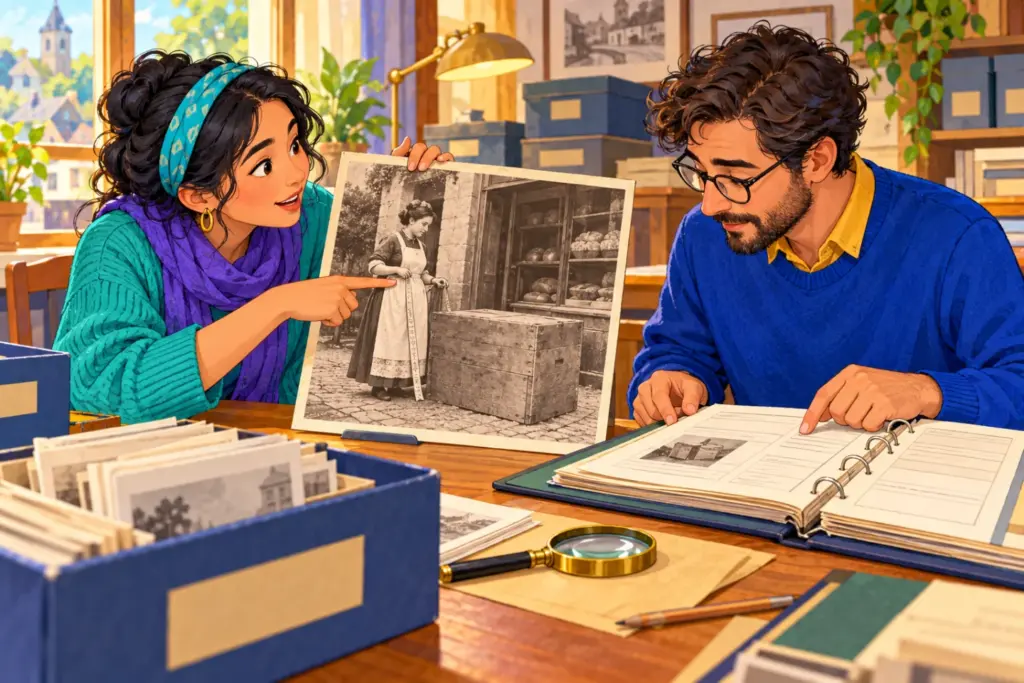
At a neighbourhood archive, Tomas was helping prepare an exhibition about ordinary working lives. One photograph showed a woman beside a large wooden box outside a bakery. The handwritten label described her as a customer waiting for bread. Tomas began copying that description onto a new display card. Across the table, his fellow volunteer Mina noticed a small detail: the woman was holding a measuring tape. She wondered whether the label told the whole story, but she had no alternative explanation yet.
Rather than announce that the label was wrong, Mina asked if they could find out who had written it. Tomas checked the donation record and discovered that the photograph had arrived with several unrelated papers. The label had been added much later by someone who was sorting the collection. That person had left no source for the description. Although the wording sounded confident, its confidence was not evidence. Mina suggested recording what they could actually see before looking for further information about the scene.
They listed the measuring tape, the empty wooden box, and a sign partly hidden behind the door. Tomas wanted to enlarge the sign immediately, but Mina asked what question the enlargement might answer. They agreed that it could identify the business or explain the box. The larger image revealed a furniture repair notice beside the bakery sign. It still did not identify the woman. Their questions had become more precise, even though they had not reached a complete answer. Tomas began to enjoy that slower progress.
The following afternoon, an older resident visited the archive to collect some copied documents. Tomas asked whether she knew anything about the two businesses in the photograph. She recognised the doorway and said her aunt had repaired furniture there. She could not identify the woman with certainty, but she offered to check a family album. Mina thanked her and wrote down exactly which details remained uncertain. She also asked permission to contact her again. No one wanted a helpful memory to turn into another unsupported label.
For the exhibition, they wrote that the photograph showed a woman holding a measuring tape outside two neighbouring businesses. They added a short question inviting visitors to share information about the furniture workshop. The unfinished description initially bothered Tomas. Then he realised that an honest question could make the display more interesting than a confident guess. Their aim was no longer to fill every gap by opening day. It was to show what they knew, explain how they knew it, and create a clear route for learning more.
A conversation to practise
Mina: Do you know who added this label?
Tomas: The record names a volunteer but gives no source.
Mina: Could you tell me whether we have the original notes?
Tomas: I will check the donation folder.
Understand the story
- Which detail first makes Mina curious?
- What does enlarging the image reveal?
- Why do they leave a question on the final display?
Practise the language
- Rewrite after Do you know: Where is the folder?
- Complete with whether: Could you tell me ___ the shop is open?
- Correct the word order: Do you know when did she arrive?
Vocabulary & explanations
English
Your goal
Use indirect questions to investigate a misunderstanding politely.
Useful vocabulary
- archive
- a collection of historical recordsThe archive keeps old street maps.
- label
- a short written description attached to somethingThe label gives the date of the photograph.
- source
- where information comes fromCan you name the source of that description?
- evidence
- information that supports a conclusionThe receipt provides evidence of the purchase.
- enlarge
- make biggerWe enlarged the image to read the sign.
- precise
- clear and exactA precise question is easier to investigate.
- certainty
- complete confidence that something is trueI cannot identify the street with certainty.
- unsupported
- without evidence to back itThey removed the unsupported claim from the card.
Indirect questions
After Could you tell me or Do you know, use statement word order: Do you know where the archive is? For yes/no questions, use if or whether: Do you know whether it is open?
- Could you tell me who wrote this?
- Do you know where the box came from?
- Could you tell me whether this date is correct?
Make it yours
Describe a puzzling everyday object. Write three indirect questions and distinguish observation from a guess.
Check and remember
Recall although from lesson 22. Use it to contrast a confident label with missing evidence.
Français
Votre objectif
Utiliser des questions indirectes pour éclaircir poliment un malentendu.
Vocabulaire utile
- archive
- archivesThe archive keeps old street maps.
- label
- étiquetteThe label gives the date of the photograph.
- source
- sourceCan you name the source of that description?
- evidence
- élément de preuveThe receipt provides evidence of the purchase.
- enlarge
- agrandirWe enlarged the image to read the sign.
- precise
- précisA precise question is easier to investigate.
- certainty
- certitudeI cannot identify the street with certainty.
- unsupported
- non étayéThey removed the unsupported claim from the card.
Les questions indirectes
Après Could you tell me ou Do you know, gardez l’ordre sujet-verbe : Do you know where the archive is? Pour une question fermée, utilisez if ou whether : Do you know whether it is open?
- Could you tell me who wrote this?
- Do you know where the box came from?
- Could you tell me whether this date is correct?
À vous de jouer
Décrivez un objet quotidien intrigant. Écrivez trois questions indirectes et distinguez observation et supposition.
Vérifier et retenir
Rappelez although de la leçon 22 et opposez une étiquette affirmative au manque de preuves.
Español
Tu objetivo
Usar preguntas indirectas para aclarar un malentendido con cortesía.
Vocabulario útil
- archive
- archivoThe archive keeps old street maps.
- label
- etiquetaThe label gives the date of the photograph.
- source
- fuenteCan you name the source of that description?
- evidence
- pruebaThe receipt provides evidence of the purchase.
- enlarge
- ampliarWe enlarged the image to read the sign.
- precise
- precisoA precise question is easier to investigate.
- certainty
- certezaI cannot identify the street with certainty.
- unsupported
- sin fundamentoThey removed the unsupported claim from the card.
Las preguntas indirectas
Después de Could you tell me o Do you know, usa el orden de una afirmación: Do you know where the archive is? Para preguntas de sí o no usa if o whether: Do you know whether it is open?
- Could you tell me who wrote this?
- Do you know where the box came from?
- Could you tell me whether this date is correct?
Hazlo tuyo
Describe un objeto cotidiano intrigante. Escribe tres preguntas indirectas y distingue observación y suposición.
Comprobar y recordar
Recuerda although de la lección 22 para contrastar una etiqueta segura con la falta de pruebas.
العربية
هدفك
استخدام الأسئلة غير المباشرة لتوضيح سوء فهم بأدب.
مفردات مفيدة
- archive
- أرشيفThe archive keeps old street maps.
- label
- بطاقة تعريفThe label gives the date of the photograph.
- source
- مصدرCan you name the source of that description?
- evidence
- دليلThe receipt provides evidence of the purchase.
- enlarge
- يكبرWe enlarged the image to read the sign.
- precise
- دقيقA precise question is easier to investigate.
- certainty
- يقينI cannot identify the street with certainty.
- unsupported
- غير مدعوم بدليلThey removed the unsupported claim from the card.
الأسئلة غير المباشرة
بعد Could you tell me أو Do you know استخدم ترتيب الجملة الخبرية: Do you know where the archive is? ولأسئلة نعم أو لا استخدم if أو whether: Do you know whether it is open?
- Could you tell me who wrote this?
- Do you know where the box came from?
- Could you tell me whether this date is correct?
دورك الآن
صف غرضا يوميا محيرا واكتب ثلاثة أسئلة غير مباشرة وميز بين الملاحظة والتخمين.
راجع وتذكّر
استرجع although من الدرس 22 لتقارن بين بطاقة جازمة وغياب الدليل.
Check your answers
Story answers
- The woman in the photograph is holding a measuring tape.
- It reveals a furniture repair notice beside the bakery sign.
- They still lack a complete answer and want visitors to share useful information.
Language answers
- Do you know where the folder is? — Use subject then verb inside an indirect question.
- whether — Whether introduces an indirect yes/no question.
- Do you know when she arrived? — Remove did and put the main verb in the past.
Français
- Dans une question indirecte, placez le sujet avant le verbe.
- Whether introduit une question indirecte fermée.
- Supprimez did et mettez le verbe principal au passé.
Español
- En la pregunta indirecta, coloca el sujeto antes del verbo.
- Whether introduce una pregunta indirecta de sí o no.
- Elimina did y pon el verbo principal en pasado.
العربية
- ضع الفاعل قبل الفعل داخل السؤال غير المباشر.
- تقدم whether سؤالا غير مباشر إجابته نعم أو لا.
- احذف did وضع الفعل الرئيسي في الماضي.